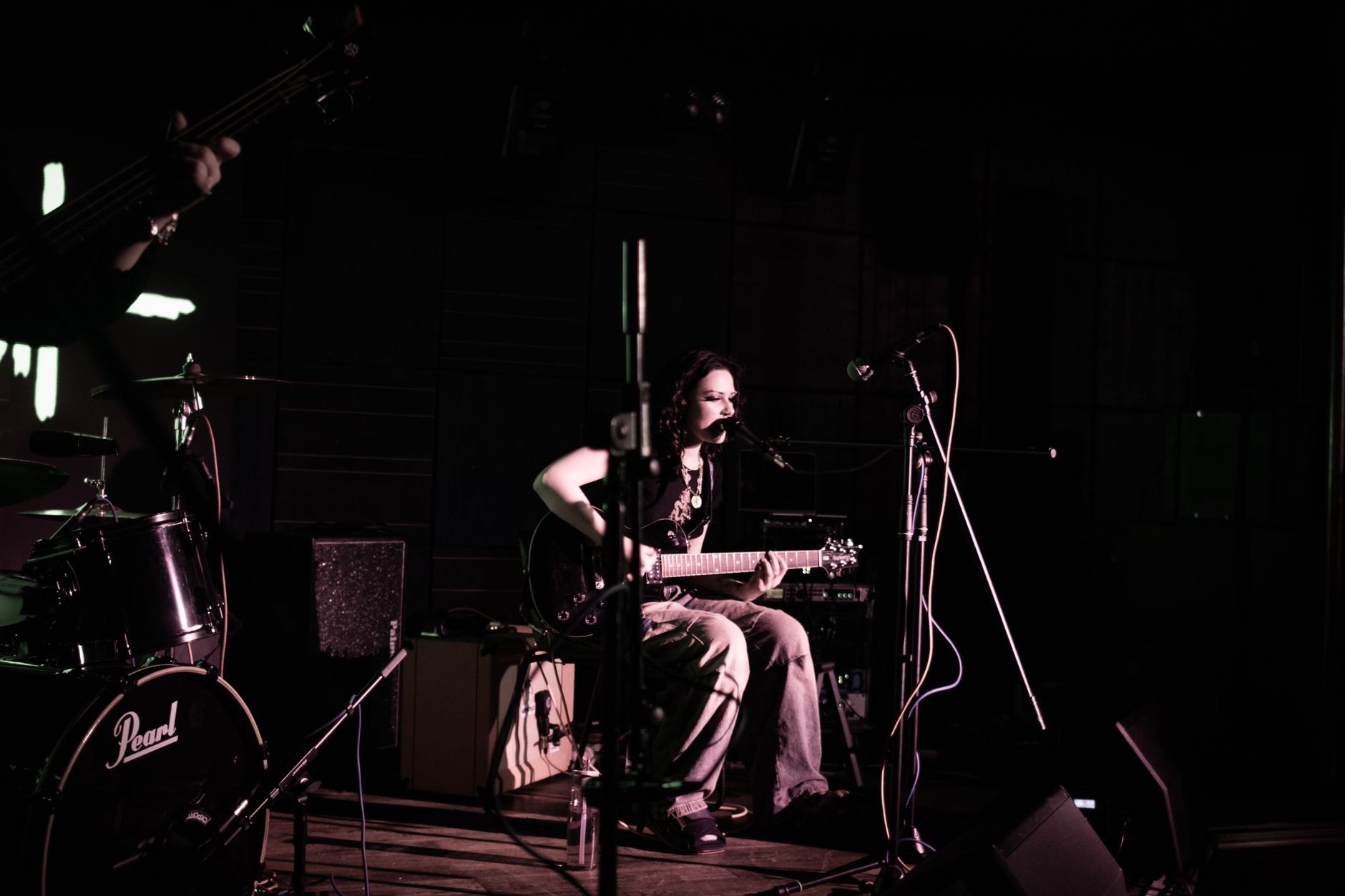
الصورة الرئيسية:Tyler Wilby / Pexels
دراسة السرد التضليلي من خلال الموسيقى الحية في سولت شيد
تبحث هذه الدراسة في التقاطع بين المشاهدة الثقافية الحديثة والادعاءات حول السيطرة المصطنعة على السرديات في صناعة الموسيقى الحية. ومن خلال الاستعانة بتقارير صحيفة شيكاغو تريبيون، نقوم بتحليل كيف تحد الأداءات الفنية الأصيلة من نزعة التشكيك المحيطة بعمليات التلاعب النفسي في الترفيه المعاصر.
In contemporary cultural discourse, the line between organic public enthusiasm and engineered narrative manipulation has grown increasingly blurred. Observers frequently apply the lexicon of psychological operations—commonly abbreviated as psyops—to mass media, advertising, and large-scale entertainment events, suspecting that public fervor is routinely fabricated by unseen industry architects. However, empirical examination of specific live music events reveals a more nuanced reality where genuine artistic expression persists independently of corporate fabrication. This article investigates the mechanisms of cultural narrative control, evaluating how real-world performance spaces like the Salt Shed serve as testing grounds for assertions about artificial versus authentic audience engagement.
Context: The Intersect of Culture and Manufactured Narratives
The modern cultural landscape is saturated with suspicion regarding how public taste is formed, directed, and sustained. Critics and cultural theorists alike frequently point to the commercial apparatus of the entertainment industry as a primary driver of engineered consensus. In this framework, popular music, viral trends, and packed concert venues are viewed not merely as expressions of collective preference, but as potential outputs of sophisticated psychological management. The underlying premise suggests that audiences are passive recipients of meticulously designed cultural scripts intended to simulate grassroots enthusiasm where none organically exists.
Understanding this phenomenon requires examining how the terminology of intelligence operations migrated into everyday media criticism. When commentators label a cultural trend or a successful artist a psyop, they are invoking a mechanism of influence designed to alter perceptions and shape group behavior without the targets realizing the manipulation. Within the music industry, accusations of astroturfing—the practice of masking the sponsors of a message or organization to make it appear as though it originates from grassroots participants—fuel this skepticism. Listeners are inundated with algorithmic recommendations, sponsored playlist placements, and aggressive marketing campaigns, making it increasingly difficult to discern between genuine critical acclaim and purchased momentum.
Yet, the application of operational psyop frameworks to live performance overlooks the physical realities of physical gathering spaces. While digital environments are readily shaped by bots, paid engagement, and algorithmic steering, the physical concert hall operates under different constraints. A live show requires financial investment, physical attendance, and real-time social interaction among hundreds or thousands of individuals. It is within this physical realm that cultural analysts must test the validity of manufactured narrative claims, measuring the distance between digital projection and tangible human participation.
الادعاء: تحليل النظارات الحديثة والهندسة الثقافية
The core assertion driving modern cultural skepticism is that large-scale audience engagement is fundamentally untrustworthy. According to this perspective, when a band sells out a prominent venue or receives effusive critical praise, these outcomes are manufactured through industry coordination rather than spontaneous public demand. Proponents of this view argue that talent agencies, record labels, and streaming platforms work in concert to project an illusion of relevance, utilizing social media amplification and industry insider networks to create self-fulfilling prophecies of success.
This narrative relies on the mechanics of social proof, a psychological phenomenon where people assume the actions of others in an attempt to reflect correct behavior for a given situation. In the context of the entertainment industry, if an entity can successfully simulate massive popularity—through inflated streaming numbers, carefully curated press coverage, and strategic ticket distribution—consumers are more likely to adopt that manufactured consensus as their own. The claim posits that what appears to be a vibrant subcultural movement is often an upper-management creation designed to monetize demographic trends and capture niche market segments.
The Mechanics of Manufactured Hype
To evaluate these claims objectively, one must examine the specific tools utilized in contemporary cultural engineering. These include coordinated social media blitzes, exclusive influencer seeding, and algorithmic biasing that prioritizes certain tracks over others regardless of direct user demand. Industry observers note that these tactics can create a distorted perception of an artist’s cultural footprint, making an act appear ubiquitous online while its physical-world impact remains minimal.
However, the existence of marketing machinery does not automatically equate to a totalizing psychological operation. A distinction must be drawn between standard commercial promotion—which seeks to make potential consumers aware of a product—and a psyop, which implies deceptive intent to subvert independent judgment. Conflating aggressive marketing with covert narrative control obscures the actual dynamics of how audiences discover, evaluate, and embrace musical acts.
What the Evidence Actually Shows: The Geese Performance at Salt Shed
Grounded observation of specific live events provides a necessary corrective to generalized cynicism. As documented in the Chicago Tribune, the rock band Geese performed a headline set at the Salt Shed, offering a clear case study in organic audience connection devoid of artificial inflation. The reporting from the Chicago Tribune details a performance characterized by raw execution and an engaged, participatory crowd that attended out of genuine artistic interest rather than algorithmic compulsion.
The evidence gathered from the Chicago Tribune review emphasizes the tangible, unscripted nature of the event. Rather than relying on backing tracks, heavy visual spectacles, or pre-packaged pop choreography, the performance centered on traditional musicianship and dynamic stage presence. The audience response—described by the Chicago Tribune as intensely physical and immediate—demonstrated none of the detached, performative compliance often associated with manufactured cultural spectacles. Attendees were drawn together by a shared affinity for the band’s sonic output, verified by the physical reality of a packed, responsive room.
| **التفاصيل التحليلية للتصنيف** --- *(Note: Since the original text is just "Analytical Category" with no context for HTML/shortcodes, this is a standalone translation. If you have specific HTML/shortcodes to preserve, they would remain unchanged in the output.)* | Manufactured Narrative / Astroturfing Claim | Empirical Evidence (Chicago Tribune on Geese at Salt Shed) |
|---|---|---|
| Audience Motivation | Driven by algorithmic coercion and peer pressure | Rooted in genuine affinity for musical output and live performance |
| Performance Mechanics | Heavily produced, reliant on backing tracks and visual distractions | Characterized by raw musicianship, dynamic execution, and physical presence |
| Social Interaction | Performative compliance designed for digital content generation | Spontaneous, unscripted communal engagement within a physical venue |
| Industry Influence | Total top-down control by labels and promoters | Bottom-up discovery and community building among independent fans |
How Narrative Control Operates in the Modern Entertainment Industry
While the Geese performance at the Salt Shed exemplifies organic cultural growth, narrative control remains a potent force in other sectors of the entertainment industry. Major conglomerates frequently deploy sophisticated public relations strategies to manage artist image, suppress negative coverage, and dictate the terms of cultural debate. Understanding these operations requires looking past the music itself to examine the structural architecture of modern media distribution.
Media consolidation plays a central role in this ecosystem. When a handful of multinational corporations control streaming services, radio conglomerates, and major festival booking agencies, the pathways for independent discovery are inherently constricted. This structural bottleneck allows executives to curate which artists receive baseline visibility, shaping the boundaries within which popular culture operates. Even if an audience genuinely enjoys an artist, the initial introduction to that artist is frequently filtered through corporate curation.
Furthermore, the weaponization of data analytics has transformed how record labels approach artist development. Instead of allowing scenes to incubate organically in local venues, labels increasingly rely on predictive modeling to identify micro-trends and manufacture acts tailored to specific demographic profiles. This data-driven approach minimizes financial risk for investors but reinforces the perception that modern culture is a product of corporate engineering rather than genuine human expression.
Red Flags: Distinguishing Between Genuine Artifice and Organic Success
For media consumers and critics navigating an environment saturated with promotion and potential manipulation, identifying objective markers of artifice is essential. Distinguishing a manufactured cultural artifact from an authentic artistic movement requires analyzing specific behavioral and structural indicators.
- Disproportionate Digital Footprint: Massive streaming numbers and viral social media engagement that fail to translate into active community participation, physical ticket sales, or local grassroots word-of-mouth.
- Over-Sanitized Public Image: Artist narratives that appear meticulously scrubbed of controversy, featuring uniform critical praise across disparate publications without substantive engagement with the music itself.
- Algorithmic Forcing: Tracks appearing persistently at the top of prominent playlists immediately upon release, independent of historical listening trends or organic user sharing patterns.
- Heavy Corporate Synergy: Immediate integration into high-budget commercial campaigns, brand sponsorships, and mainstream media synchronization before the artist has established a foundational live following.
- Performative Spectacle Over Substance: Concerts that rely heavily on backing tracks, pre-recorded visual elements, and choreographed audience reactions while minimizing live musical improvisation.
Institutional Perspective: Reporting from the Chicago Tribune
Journalistic institutions play a vital role in grounding cultural analysis in verifiable observation. As demonstrated by the Chicago Tribune coverage of the Geese concert at the Salt Shed, on-the-ground music criticism serves as an essential counterweight to both uncritical industry promotion and cynical conspiracy theories.
Professional reviewers operating within established news organizations bring methodological rigor to cultural events. By attending performances in person, observing crowd dynamics, and evaluating technical execution, journalists provide an independent record that cuts through digital noise. The Chicago Tribune report avoids the hyperbole typical of sponsored content while simultaneously rejecting the blanket cynicism of internet commentators who dismiss all modern culture as a fabricated psyop.
This empirical reporting underscores why local arts journalism remains indispensable. When critics document the specific atmosphere of a venue like the Salt Shed, they create a public archive of genuine cultural activity. This documentation protects against both corporate revisionism and the erosion of public trust in shared cultural experiences.
What the Audience Experience Reveals About Media Authenticity
The ultimate test of any cultural artifact or performance lies in the lived experience of the audience. While digital spaces can be manipulated through bots, paid amplification, and curated aesthetics, the physical concert environment forces an encounter with reality. Attendees at events like the Geese performance engage in sensory evaluation that goes beyond what can be engineered through a screen.
Audience members assess authenticity through visceral markers: the volume of the amplifiers, the interaction between band members on stage, the spontaneity of the crowd’s movement, and the absence of corporate messaging in the immediate performance space. These tactile elements resist digital simulation. When an audience responds to a band with unscripted enthusiasm in a physical room, it signals a breakdown of top-down narrative control and a return to horizontal, community-based cultural appreciation.
Consequently, the endurance of live music acts as a stabilizing force against excessive media skepticism. While acknowledging the real presence of corporate curation and narrative manipulation in the broader entertainment industry, direct participation in live events reminds observers that human creativity and communal bonding continue to operate independently of engineered consensus.
Frequently Asked Questions Regarding Cultural Psyops and Live Events
What is a cultural psyop in the context of the music industry?
A cultural psyop refers to the theoretical or actual use of coordinated psychological strategies, media campaigns, and astroturfing to shape public taste and manufacture consensus around specific artists or trends without audience awareness.
How do live music performances differ from digital media regarding narrative control?
Live music requires physical attendance, financial investment, and unscripted social interaction in a shared space, making it significantly harder to fabricate entirely through digital manipulation, bots, or corporate steering.
What did the Chicago Tribune report about the Geese performance at the Salt Shed?
Reporting from the Chicago Tribune documented an authentic, highly engaging rock performance characterized by raw musicianship and a responsive, organic crowd rather than manufactured industry spectacle.
How can consumers tell the difference between organic success and manufactured hype?
Consumers can look for red flags such as disproportionate streaming numbers that fail to translate into real-world ticket sales, heavy corporate synergy before an established fanbase exists, and an over-reliance on algorithmic playlist placement.
Does the existence of industry marketing mean all popular music is fake?
No. While major record labels and streaming platforms utilize aggressive promotional tactics and data analytics to guide consumer attention, genuine artistic talent and organic subcultural movements continue to thrive alongside commercial infrastructure.