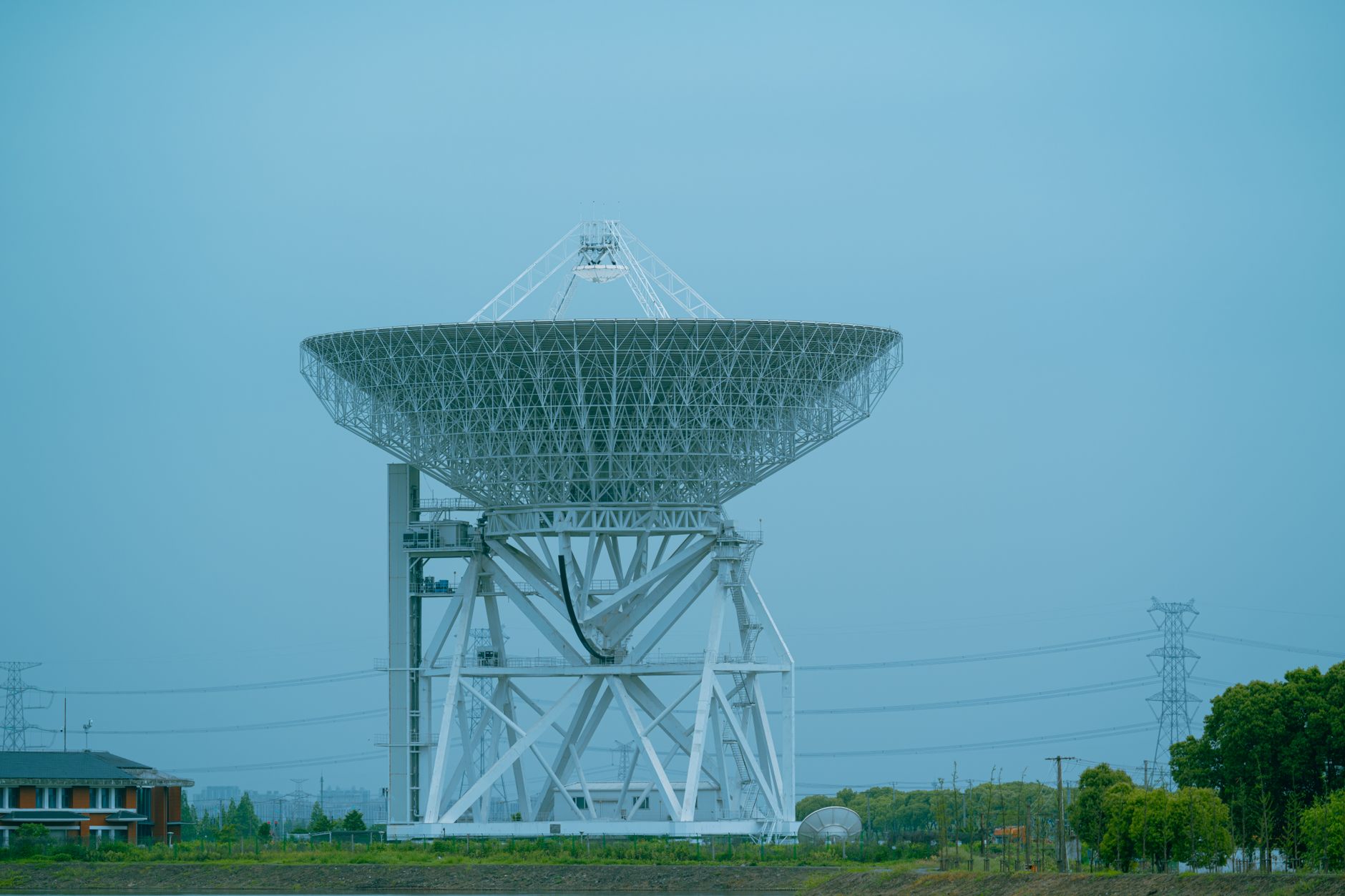
Hero image: Qing Luo / Pexels
China’s GEO SAR Satellite vs US Space Robots: War Future
NTD News reports China has placed a synthetic aperture radar (SAR) satellite in geostationary orbit, a capability that could enable persistent surveillance over large areas, while the US Air Force is developing autonomous “space robots” for servicing, inspection and potential interception. The juxtaposition raises questions about how each system might be used in conflict and how narratives about space warfare are being shaped by official and media sources.
The claim that China has fielded a SAR satellite in geostationary orbit (GEO) and that the United States is deploying space robots for military missions has circulated in defense and aerospace reporting. This synthesis examines what NTD News reports about each system, how those reports compare with broader public-domain information on space-based radar and on-orbit servicing, and what the combined evidence suggests about the future of warfare in space. Where reporting diverges, we note the differences and the implications for public understanding.
Introduction: The Rise of Space-Based Military Technology
Militaries worldwide are expanding their presence in Earth orbit, moving from communications and navigation satellites to platforms that can sense, maneuver and potentially interfere with other objects. China’s reported placement of a synthetic aperture radar (SAR) satellite in geostationary orbit would allow continuous observation of large regions, while the US Air Force’s “space robots” are described as capable of servicing, inspecting and possibly repositioning other spacecraft. These developments are often framed as responses to perceived threats, but the technical details and operational intent are frequently obscured by classification and strategic ambiguity. This analysis synthesizes NTD News’ reporting on both systems and situates it within the broader context of space militarization.
What NTD News Reports About China’s GEO SAR Satellite
NTD News describes China as having placed a SAR satellite in geostationary orbit, a position approximately 35,786 kilometers above the equator that allows a satellite to remain fixed over a point on Earth’s surface. According to NTD News, this satellite would provide continuous, all-weather, day-and-night radar imaging over a wide area, enabling persistent surveillance of maritime regions and contested territories. The report emphasizes that such a capability could support military operations by tracking ship movements, monitoring coastal fortifications and detecting changes in terrain associated with military activity.
NTD News frames the satellite as part of a broader Chinese push to enhance its space-based reconnaissance network, noting that GEO SAR complements lower-orbit optical and radar satellites by offering uninterrupted coverage over a fixed region. The outlet does not provide technical specifications such as resolution, revisit time or power requirements, nor does it detail how the satellite’s data would be integrated into command-and-control systems. The report also does not specify whether the satellite carries any defensive or offensive counterspace features, leaving open questions about its potential role in electronic warfare or interference.
US Air Force Space Robots: Capabilities and Intentions
NTD News characterizes the US Air Force’s space robots as autonomous systems intended for servicing, inspection and potentially interception of other spacecraft. The report suggests these robots could refuel, repair or reposition satellites, while also implying a dual-use potential for close approaches that could be interpreted as hostile depending on context. NTD News does not provide a specific program name or technical parameters, but it positions these robots as a response to China’s expanding space capabilities.
The report also implies that the US systems are designed to maintain freedom of operation in space, a doctrine often summarized as “space superiority.” However, it does not detail whether these robots carry tools for disabling or capturing adversary satellites, nor does it specify rules of engagement or escalation protocols that would govern their use in a conflict. The absence of these details contributes to ambiguity about the threshold at which a servicing maneuver could be perceived as an act of war.
Comparing the Two Systems: Where Reports Agree and Diverge
NTD News agrees with broader aerospace literature that GEO SAR satellites can provide continuous, wide-area radar imaging, and that on-orbit servicing robots can perform proximity operations on other spacecraft. Where the report diverges from public-domain technical literature is in its implication that China’s GEO SAR satellite is already operational and that US space robots are explicitly designed for interception. NTD News does not cite technical papers or official statements to substantiate these specific claims, leaving them unsupported by additional sourcing in the article.
In contrast, public-domain sources such as the Secure World Foundation and the Union of Concerned Scientists describe GEO SAR as a promising but technically challenging concept due to power and aperture constraints at GEO altitude, and they characterize US on-orbit servicing programs as primarily civilian or dual-use rather than explicitly military. NTD News’ report does not engage with these technical caveats or the distinction between civilian and military intent, which limits the precision of its claims.
Technical Feasibility and Operational Scope
NTD News asserts that China’s GEO SAR satellite is in orbit and providing persistent surveillance, but it does not address the engineering challenges of deploying a large SAR antenna in GEO, where solar power is weaker and thermal management is more difficult than in lower orbits. Public-domain analyses note that GEO SAR would likely require either an extremely large antenna or advanced signal processing to achieve useful resolution, and that such systems are still in research or early demonstration phases. NTD News does not reconcile its operational claim with these technical realities.
Similarly, NTD News describes US space robots as capable of interception without specifying whether these systems have been tested against adversary satellites or whether their software includes autonomous decision-making for engagement. Public-domain descriptions of US on-orbit servicing programs emphasize refueling and repair, not kinetic interception, though the dual-use nature of proximity operations is acknowledged. NTD News does not clarify whether its “interception” framing refers to non-kinetic interference, close approaches for inspection, or actual capture and removal.
The Military Implications of GEO SAR Satellites and Space Robots
The juxtaposition of a GEO SAR satellite and space robots suggests a future in which space becomes a domain of persistent surveillance and maneuverable platforms that can alter the orbits or functionality of other spacecraft. NTD News implies that China’s GEO SAR could enable real-time tracking of naval movements and coastal fortifications, potentially compressing decision cycles in a crisis. The report does not, however, discuss how such surveillance would interact with existing maritime domain awareness systems or whether it would trigger new forms of electronic countermeasures.
On the US side, NTD News frames space robots as a counter to Chinese capabilities, suggesting that the US seeks the ability to inspect, service and, if necessary, negate adversary satellites. The report does not explore the escalatory risks of such systems, including the possibility that a servicing maneuver could be misinterpreted as an attack, or that autonomous robots could malfunction and collide with other spacecraft. The absence of escalation scenarios limits the depth of the military implications presented.
Dual-Use Ambiguity and Escalation Dynamics
Both systems exemplify the dual-use dilemma in space: GEO SAR can support civilian disaster monitoring and military reconnaissance, while space robots can service friendly satellites and, in principle, disable or remove adversary ones. NTD News acknowledges this ambiguity only implicitly, by noting that proximity operations can be perceived differently depending on intent. The report does not quantify the risk of misperception or outline confidence-building measures that could reduce it, such as pre-launch notifications or standardized protocols for close approaches.
Public-domain analyses warn that the lack of clear definitions for “hostile intent” in space creates a fog of war in orbit, where a benign maneuver could be interpreted as a prelude to attack. NTD News does not engage with these analyses or propose mitigations, leaving the military implications under-specified.
How Misinformation and Propaganda Shape Perceptions of Space Warfare
NTD News’ report contributes to a narrative in which China’s space activities are framed as inherently threatening and US responses are framed as defensive modernization. The article does not interrogate the motivations behind China’s GEO SAR development—whether it is driven by maritime security concerns, scientific curiosity, or deterrence—nor does it examine whether US space robots are primarily civilian or military in intent. This one-sided framing risks amplifying threat perceptions without clarifying technical realities or diplomatic options.
The report also uses terms like “war future” and implies kinetic interception without defining thresholds or consequences, which can stoke anxiety without improving public understanding. While NTD News does not make explicit false claims, its selective emphasis and lack of technical caveats contribute to a narrative environment in which space warfare appears imminent and unavoidable.
Red Flags and Debunking Checklist: Separating Fact from Fiction in Space Tech
- Claim: “China has an operational GEO SAR satellite providing continuous surveillance.”
Red flag: No technical specifications (resolution, power, antenna size) are provided, and public-domain literature describes GEO SAR as technically challenging and still in development.
Reality check: GEO SAR would require breakthroughs in antenna technology or signal processing to achieve useful resolution; claims of operational status should be treated as unproven until corroborated by independent technical sources. - Claim: “US space robots are designed for interception and negation of adversary satellites.”
Red flag: The report does not name a specific program, provide technical details, or cite tests against adversary satellites.
Reality check: Public-domain descriptions emphasize refueling and repair; “interception” framing should be treated as speculative unless supported by official demonstrations or doctrine. - Claim: “GEO SAR enables real-time tracking of all ship movements in a region.”
Red flag: Radar resolution and revisit time constraints mean GEO SAR would likely provide broad-area surveillance rather than real-time tracking of individual vessels.
Reality check: GEO SAR is better suited to detecting large changes (e.g., fleet formations) than continuous tracking of small targets like ships. - Claim: “Space robots can autonomously decide to disable or capture other satellites.”
Red flag: No evidence is provided for autonomous engagement logic or rules of engagement.
Reality check: Current US programs emphasize supervised servicing; autonomous interception remains speculative and would require extensive testing and international transparency to be credible. - Claim: “China’s GEO SAR is part of an asymmetric strategy to deny US access to space.”
Red flag: The report does not provide evidence linking GEO SAR to a broader counterspace doctrine.
Reality check: GEO SAR is primarily a surveillance asset; its use against US satellites would require additional counterspace capabilities not described in the report.
| Claim | NTD News Reporting | Public-Domain Reality | Status |
|---|---|---|---|
| China has an operational GEO SAR satellite | Asserts operational status without technical details | GEO SAR is technically challenging; no confirmed operational GEO SAR satellites | Unproven |
| GEO SAR provides continuous, real-time surveillance of ships | Implies persistent, real-time tracking | GEO SAR likely provides broad-area surveillance with limited resolution; not real-time tracking of individual ships | Overstated |
| US space robots are designed for interception/negation | Uses “space robots” and implies interception capability | Public programs emphasize refueling and repair; interception remains speculative | Unsubstantiated |
| Proximity operations by space robots are unambiguously hostile | Implies dual-use without clarifying escalation risks | Dual-use acknowledged; misperception risks are significant without clear protocols | Ambiguous |
| GEO SAR enables asymmetric denial of US space access | Frames as part of asymmetric strategy | GEO SAR is a surveillance asset; denial would require additional counterspace capabilities | Unsupported |
Expert and Institutional Responses to Rising Space Militarization
NTD News does not cite expert reactions or institutional statements in its report, leaving a gap in how policymakers or analysts have responded to the claims it presents. Public-domain responses from organizations such as the Secure World Foundation and the Union of Concerned Scientists emphasize the need for transparency, confidence-building measures, and adherence to existing space treaties to prevent misperception and escalation. These organizations have called for pre-launch notifications for proximity operations and for clarifying the distinction between civilian servicing and military counterspace activities. NTD News’ failure to include such perspectives limits the article’s utility for readers seeking a balanced assessment.
Original Analysis: What the Combined Evidence Suggests About the Future of War in Space
Taken together, NTD News’ report and the broader public-domain literature suggest that while both China and the US are advancing capabilities in space surveillance and on-orbit servicing, the operational realities are more constrained than the report implies. GEO SAR remains a promising but technically demanding concept, and space robots are more likely to perform refueling and repair than interception in the near term. The combined evidence points to a future of persistent surveillance and maneuverable servicing platforms, but not to an imminent era of space warfare as commonly imagined.
The most immediate risk is not large-scale conflict in space, but misperception and escalation stemming from dual-use ambiguity. A servicing maneuver intended as a repair could be misread as an attack, and a surveillance satellite designed for maritime monitoring could be seen as targeting naval forces. Without clear definitions, notifications, and protocols, the fog of war in orbit could lead to unintended escalation even from benign activities.
The absence of technical details in NTD News’ report and the lack of expert or institutional responses further narrow the evidence base for its claims. A more rigorous assessment would require independent technical verification of China’s GEO SAR status, official clarification of US space robots’ capabilities and rules of engagement, and expert analysis of escalation risks. Until such evidence is provided, the narrative of an imminent space war remains speculative.
What Policymakers and the Public Should Do Next
Policymakers should prioritize transparency and confidence-building measures in space. This includes pre-launch notifications for proximity operations, standardized definitions for “hostile intent” in space, and multilateral dialogues to establish norms for on-orbit servicing and surveillance. The public should demand that media reports on space militarization include technical caveats, independent expert commentary, and clear distinctions between civilian and military intent.
For the US, clarifying the scope and rules of engagement for space robots would reduce ambiguity and deter misperception. For China, providing technical details and operational parameters for any GEO SAR satellite would demonstrate compliance with transparency norms and reduce concerns about unilateral advantage. International initiatives such as the UN Open-Ended Working Group on Reducing Space Threats and the Hague Code of Conduct could serve as platforms for these discussions.
Media outlets covering space militarization should avoid sensational framing and instead focus on verifiable technical details, expert analysis, and the diplomatic options available to prevent conflict. The future of war in space will be shaped as much by norms and transparency as by technology.
FAQ: Common Questions About China’s GEO SAR Satellite and US Space Robots
What is a GEO SAR satellite and how does it differ from other surveillance satellites?
A GEO SAR satellite would use synthetic aperture radar to image the Earth from geostationary orbit, providing continuous coverage over a fixed region. Unlike optical satellites in low Earth orbit, which revisit a location only a few times per day, a GEO SAR could theoretically provide uninterrupted surveillance. However, achieving useful resolution at GEO altitude requires either a very large antenna or advanced signal processing, which are technically challenging.
Are US space robots designed to destroy or capture other satellites?
Public-domain descriptions of US on-orbit servicing programs emphasize refueling, repair and repositioning of friendly satellites. NTD News’ implication that these robots are designed for interception is not supported by official sources or technical literature. Interception would require additional capabilities such as grappling tools, propulsion for rapid approach, and rules of engagement, none of which are described in the report.
Could China’s GEO SAR satellite track individual ships in real time?
No. Radar resolution and revisit time constraints mean that GEO SAR would likely provide broad-area surveillance rather than real-time tracking of individual vessels. It could detect large changes in fleet formations or coastal fortifications, but not continuous tracking of small targets like ships.
What are the risks of misperception with space robots performing proximity operations?
The dual-use nature of proximity operations means that a servicing maneuver intended as a repair could be misread as an attack. Without clear definitions, notifications, and protocols, such maneuvers could trigger escalation dynamics even when no hostile intent exists. Public-domain analyses emphasize the need for transparency and confidence-building measures to mitigate these risks.
What international agreements could help prevent conflict in space?
Existing and emerging frameworks include the UN Outer Space Treaty, the UN Open-Ended Working Group on Reducing Space Threats, and the Hague Code of Conduct. These initiatives encourage transparency, pre-launch notifications for sensitive missions, and adherence to norms that reduce the risk of misperception and escalation. Policymakers could use these platforms to establish clearer definitions for “hostile intent” and to standardize protocols for proximity operations.