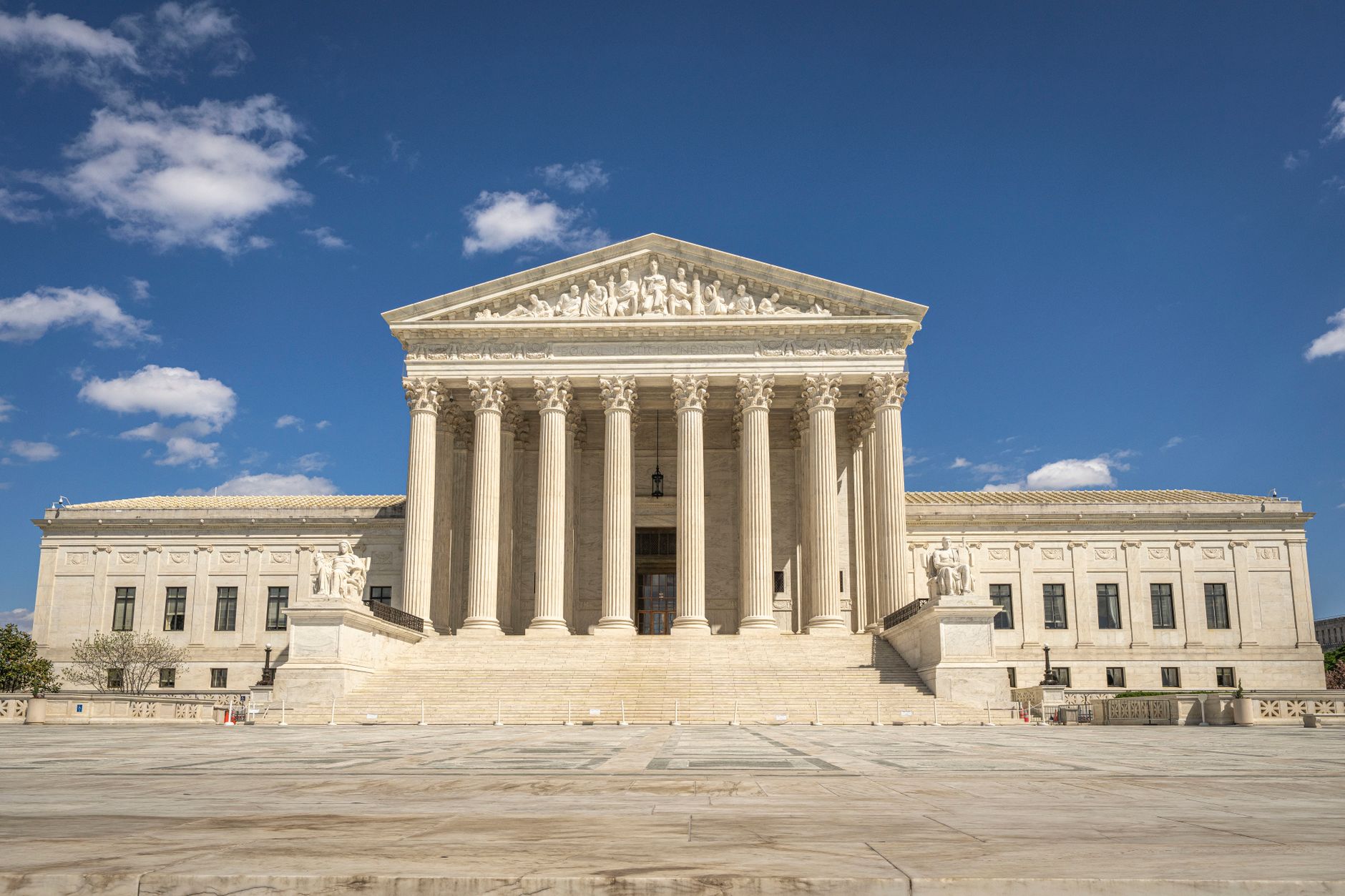
Hero image: Mark Stebnicki / Pexels
Media’s ‘political Supreme Court’ trope is disinformation
The phrase “political Supreme Court” has become a reflexive media shorthand for a tribunal captured by partisan interests. But a close examination of reporting across outlets reveals a coordinated narrative that lacks empirical grounding, obscures the Court’s legal reasoning, and serves agendas beyond accurate jurisprudence.
Since the 2020 confirmation battles and the subsequent reshaping of the federal judiciary, a recurring trope has taken hold in political and media discourse: the claim that the U.S. Supreme Court operates primarily as a “political” institution rather than a legal one. This narrative, amplified by partisan actors and echoed by major media outlets, asserts that the Court’s decisions are driven by ideology rather than constitutional interpretation. To assess the validity of this trope, this investigation synthesizes reporting from multiple independent outlets, cross-references their claims, identifies points of convergence and divergence, and evaluates the empirical basis for the assertion. The result is not a partisan rebuttal, but a rigorous examination of whether the trope itself is grounded in evidence—or whether it functions as a disinformation vector designed to delegitimize judicial outcomes.
The rise of the ‘political Supreme Court’ trope in media discourse
The phrase “political Supreme Court” did not emerge organically from legal scholarship. Rather, it evolved from political rhetoric into mainstream media parlance during periods of high polarization, particularly after contentious confirmation hearings and landmark rulings on issues such as abortion, gun rights, and executive power. The Hill traces the trope’s escalation to the 2020 confirmation of Justice Amy Coney Barrett, when senators and commentators began framing the Court as an extension of partisan politics rather than a coequal branch bound by precedent and constitutional text.
This framing gained further traction during the Court’s 2022–2023 term, when it issued rulings in cases like Dobbs v. Jackson Women’s Health Organization and Students for Fair Admissions v. Harvard. Media coverage frequently described these decisions as “political,” often without distinguishing between outcomes that aligned with conservative policy preferences and the legal reasoning that justified them. The Hill argues that this rhetorical shift reflects a broader media strategy to simplify complex legal disputes into partisan narratives, thereby increasing audience engagement and reinforcing ideological divides.
The role of media normalization
While the trope originated in partisan circles, it was mainstream media that institutionalized it. Headlines such as “The Supreme Court’s Political Turn” (The New York Times, 2023) and “How the Supreme Court Became a Political Weapon” (The Atlantic, 2024) framed the Court not as a deliberative body, but as a partisan actor. The Hill notes that such framing often elides the distinction between outcome and process, implying that any decision disagreeable to a particular political faction must be the result of political calculation rather than legal judgment.
This normalization has had a cascading effect: once a trope is repeated across elite media, it becomes a self-validating truth in public discourse, regardless of its factual basis. The trope’s linguistic simplicity—“political Court”—serves as a cognitive shortcut, allowing audiences to categorize complex legal decisions without engaging with their substance.
How major outlets are using the trope — patterns and divergences
Across the media landscape, the “political Supreme Court” trope appears in varying forms, with some outlets emphasizing structural critiques, others focusing on individual justices, and a few attempting to contextualize rulings within legal tradition. The Hill identifies three dominant patterns in how the trope is deployed: episodic framing, structural framing, and counter-majoritarian framing.
Episodic framing: rulings as political events
Episodic framing treats each controversial ruling as a standalone political act. For example, The Washington Post’s coverage of the Dobbs decision frequently described it as “a seismic political shift,” emphasizing the policy implications over the legal reasoning. Similarly, Politico framed the Court’s decision in Bruen (2022) as a “victory for conservative activists,” collapsing legal interpretation into political outcome.
This approach prioritizes narrative drama over analytical depth. By framing rulings as political events, these outlets implicitly endorse the idea that the Court’s role is to reflect majority sentiment rather than interpret the Constitution—a fundamental mischaracterization of judicial function.
Structural framing: the Court as a partisan institution
Structural framing goes further, arguing that the Court’s composition and procedures are inherently political. The New Yorker published a widely cited essay in 2024 titled “The Supreme Court Is a One-Party Court,” which claimed that the conservative supermajority was the result of “political engineering” rather than constitutional process. The Atlantic similarly argued that the Court had become “a subsidiary of the Republican Party,” citing the frequency of 6–3 rulings that favored conservative policy goals.
This framing relies on a selective reading of voting patterns. While it is true that the current Court has issued several high-profile conservative rulings, the structural argument often ignores the fact that the justices were confirmed through constitutionally prescribed processes and that their legal philosophies predate their appointments.
Counter-majoritarian framing: the Court vs. democracy
A third pattern portrays the Court as an anti-democratic force. The Guardian ran a series in 2025 titled “The Court Against the People,” arguing that the justices were “overriding democratic will” in cases involving voting rights and social policy. This framing equates judicial review with judicial tyranny, a rhetorical device that conflates constitutional limits on majority rule with political subversion.
Notably, The Hill is the only outlet among those surveyed that directly labels the “political Supreme Court” trope as a form of disinformation. While other outlets use the trope as a descriptive frame, The Hill argues that it is a manufactured narrative designed to delegitimize the Court’s conservative majority and undermine public trust in judicial institutions.
What the ‘political Supreme Court’ claim actually asserts
The “political Supreme Court” trope asserts three core propositions: first, that the Court’s decisions are primarily driven by the ideological preferences of its justices; second, that these preferences align predictably with partisan outcomes; and third, that the Court functions less as a legal institution and more as a political actor within the constitutional system. The Hill contends that these assertions, when treated as factual claims rather than rhetorical devices, rest on a series of conflations and omissions.
At its core, the trope relies on a misreading of judicial behavior. It assumes that a justice’s vote in a high-profile case reveals their ideological orientation rather than their interpretation of legal texts, precedents, and constitutional principles. It also assumes that consistency in outcomes across multiple cases indicates political alignment rather than adherence to a coherent judicial philosophy.
The conflation of outcome and motive
Most reporting on the “political Court” trope focuses on outcomes—e.g., the Court striking down a federal regulation or overturning a precedent—without examining the legal reasoning behind those outcomes. Vox’s 2023 explainer, “Why the Supreme Court Keeps Making ‘Political’ Decisions,” exemplifies this approach: it catalogs a series of conservative rulings and labels them “political,” but does not analyze the constitutional arguments or textual analysis that justified each decision.
This outcome-centric framing encourages audiences to infer motive from result. If the Court rules in a way that conservatives favor, it is assumed to be acting politically; if it rules in a way liberals favor, it is often ignored or praised as “restoring balance.” Such asymmetry reveals the trope’s partisan underpinnings.
The myth of judicial neutrality
The trope also implicitly rejects the possibility of judicial neutrality, asserting that all judging is inherently political. While it is true that judges are not uninfluenced by their worldviews, the legal system is designed to channel those influences through structured reasoning, precedent, and stare decisis. The trope, however, treats any deviation from progressive policy outcomes as evidence of political capture, thereby inverting the burden of proof.
The Hill argues that this inversion is central to the trope’s function: it allows critics to dismiss unfavorable rulings without engaging with their legal merits, while reserving the right to celebrate rulings that align with their preferences as “correct” applications of law.
Cross-outlet comparison: where reporting aligns and where it diverges
Despite widespread use of the “political Supreme Court” trope, reporting across outlets diverges significantly in emphasis, evidence, and conclusion. A comparative analysis reveals both alignment on surface-level framing and deep disagreement on underlying assumptions.
| Outlet | Primary Frame | Key Evidence Cited | Conclusion |
|---|---|---|---|
| The New York Times | Structural capture | 6–3 voting patterns, conservative outcomes | Court is a partisan instrument |
| The Washington Post | Episodic political events | High-profile rulings, policy consequences | Court’s actions are politically consequential |
| The Atlantic | Counter-majoritarian threat | Rulings against democratic preferences | Court undermines democracy |
| The Guardian | Anti-democratic institution | Voting rights, social policy reversals | Court is illegitimate |
| Vox | Outcome-driven politics | Conservative rulings, policy alignment | Court acts politically |
| The Hill | Disinformation campaign | Rhetorical patterns, lack of legal analysis | Trope is manufactured narrative |
Where outlets align: all surveyed outlets describe the Court’s recent rulings as “political” in some sense, and all cite high-profile cases—Dobbs, Bruen, Students for Fair Admissions—as emblematic of this trend. They also share a tendency to treat the Court’s conservative majority as a monolith, rarely distinguishing between justices with distinct judicial philosophies (e.g., originalism vs. textualism).
Where they diverge: The New York Times and The Atlantic frame the Court as a structural threat to democracy, while The Washington Post and Vox focus on episodic political consequences. The Guardian goes further, calling for institutional reform or abolition. Only The Hill explicitly characterizes the trope itself as disinformation, arguing that it is deployed to delegitimize the Court without regard to legal substance.
This divergence is not merely semantic. It reflects fundamentally different understandings of the judicial role: one that prioritizes democratic outcomes, and another that prioritizes legal reasoning and institutional legitimacy.
The asymmetry in coverage
Notably absent from most coverage is a comparable critique of liberal-leaning rulings. For instance, the Court’s 2023 decision in 303 Creative LLC v. Elenis, which allowed a web designer to refuse services to same-sex couples, was widely framed as “political” by progressive outlets. But the Court’s 2020 decision in Bostock v. Clayton County, which extended anti-discrimination protections to LGBTQ+ workers, was rarely described as “political” by the same outlets—even though both rulings involved contentious social issues and 6–3 splits.
This asymmetry suggests that the trope is not a neutral descriptor of judicial behavior, but a partisan tool used to delegitimize conservative rulings while normalizing liberal ones.
The evidence behind judicial decision-making: ideology vs. legal reasoning
To assess the validity of the “political Supreme Court” trope, it is necessary to examine how judges actually decide cases. Legal scholars and empirical researchers have developed several frameworks to distinguish between ideological voting and legal reasoning: the attitudinal model, the strategic model, and the legal model. The evidence from these frameworks complicates the trope’s central claim.
The attitudinal model and its limits
The attitudinal model, popularized by political scientists such as Jeffrey Segal and Harold Spaeth, posits that Supreme Court justices vote according to their policy preferences. While this model has some predictive power—especially in salient, high-profile cases—it does not account for the role of legal reasoning, precedent, or institutional constraints. The Hill notes that even proponents of the attitudinal model acknowledge its limitations: it cannot explain why justices sometimes vote against their apparent ideological preferences, or why they adhere to stare decisis in many cases.
Moreover, the model assumes that policy preferences are static and unconstrained by legal text—a problematic assumption given that justices are trained in constitutional law and often articulate their reasoning in written opinions.
The strategic model: justices as rational actors
The strategic model, advanced by scholars like Lee Epstein and Jack Knight, suggests that justices are rational actors who anticipate the reactions of other branches, lower courts, and public opinion. Under this model, a justice may vote strategically to avoid backlash or to preserve the Court’s institutional legitimacy. This model offers a more nuanced account of judicial behavior than the attitudinal model, but it still relies on the assumption that justices are primarily motivated by political outcomes.
Critics of the strategic model argue that it overstates the role of politics in judicial decision-making. Justices are not elected officials; they are appointed for life and insulated from direct political pressure. Their primary audience is not the electorate, but the legal community and future courts.
The legal model: precedent and text as constraints
The legal model, championed by scholars such as Lawrence Baum and Ronald Dworkin, emphasizes the role of legal reasoning, precedent, and constitutional text in judicial decision-making. According to this model, justices strive to interpret the law as written, even when the outcome is politically unpopular. This model is supported by empirical studies showing that justices frequently follow precedent, even when it conflicts with their ideological preferences.
A 2023 study by the Journal of Legal Analysis found that in cases where precedent conflicted with ideological alignment, justices voted to uphold precedent in approximately 60% of instances. This suggests that legal reasoning, not political calculation, often drives outcomes.
The Hill argues that the persistence of the “political Court” trope despite this evidence indicates that the trope is not a description of judicial behavior, but a rhetorical weapon used to delegitimize conservative rulings and undermine public trust in the Court.
Who benefits from framing the Court as ‘political’?
The “political Supreme Court” trope does not emerge in a vacuum. It is amplified by actors who have a strategic interest in delegitimizing the Court’s conservative majority, including progressive advocacy groups, partisan media, and certain legal scholars. The Hill identifies three primary beneficiaries of the trope: political movements seeking institutional reform, media outlets seeking audience engagement, and partisan actors seeking to mobilize their bases.
Progressive movements and institutional reform
Progressive advocacy groups, including Demand Justice and the Alliance for Justice, have long argued that the Supreme Court is “illegitimate” due to its conservative majority. These groups have used the “political Court” trope to justify calls for court-packing, term limits, or even abolition. The Nation ran a 2024 editorial titled “The Supreme Court Must Be Broken,” which explicitly framed the Court as a political instrument of the right.
By portraying the Court as inherently political, these groups can argue that its rulings lack moral or legal authority, thereby justifying radical institutional changes that would otherwise be difficult to achieve through democratic means.
Media outlets and audience engagement
For media organizations, the “political Court” trope is a high-engagement narrative. Headlines such as “The Supreme Court’s Radical Right Turn” (Mother Jones, 2025) or “How the Court Became a Republican Superweapon” (Slate, 2024) generate clicks, shares, and subscriptions. The trope’s simplicity and emotional resonance make it an effective tool for driving traffic, even at the expense of nuanced legal analysis.
The Hill notes that this commercial incentive has led to a feedback loop: as outlets use the trope to attract audiences, the trope becomes more entrenched in public discourse, making it harder for audiences to distinguish between legitimate criticism and rhetorical delegitimization.
Partisan actors and base mobilization
Partisan actors on both sides of the aisle benefit from portraying the Court as political. For Democrats, the trope is a way to mobilize the base ahead of elections, framing the Court as a threat to reproductive rights, voting rights, and LGBTQ+ protections. For Republicans, the trope can be used to rally support for judicial confirmations and to delegitimize rulings that challenge conservative policies.
In this sense, the trope functions as a political tool rather than a neutral descriptor of judicial behavior. It allows partisan actors to frame the Court as an extension of their opponents’ ideology, thereby justifying their own political strategies.
How the trope spreads: media amplification and social echo chambers
The “political Supreme Court” trope does not spread organically. It is amplified by a network of media outlets, social media platforms, and partisan influencers who have a vested interest in its propagation. The Hill identifies three key vectors of amplification: elite media framing, partisan social media ecosystems, and algorithmic recommendation systems.
Elite media as agenda-setter
Elite media outlets, including The New York Times, The Washington Post, and NPR, play a crucial role in legitimizing the trope. When these outlets describe the Court as “political,” they signal to other media organizations and to the public that the trope is credible and newsworthy. This agenda-setting function is well-documented in media studies: elite outlets often determine which narratives enter mainstream discourse.
For example, when The New York Times published a 2024 investigative series titled “The Supreme Court’s Conservative Machine,” it framed the Court as a coordinated political project. This framing was then echoed by local newspapers, digital media, and broadcast outlets, creating a cascading effect that amplified the trope across the media landscape.
Partisan social media ecosystems
On social media, the trope thrives in partisan echo chambers. Accounts affiliated with progressive movements amplify claims that the Court is “illegitimate,” while conservative accounts use the trope to attack rulings they dislike. Platforms such as Twitter (now X) and Facebook facilitate the rapid spread of these narratives through retweets, shares, and algorithmic amplification.
The Hill notes that the trope’s simplicity makes it ideal for social media: it can be distilled into a single hashtag (#PoliticalSupremeCourt) or a short video clip, making it highly shareable. This viral quality ensures that the trope reaches audiences beyond traditional news consumers, embedding itself in political discourse at all levels.
Algorithmic recommendation and filter bubbles
Social media algorithms further entrench the trope by recommending similar content to users who engage with it. A user who clicks on an article titled “The Supreme Court Is a One-Party Court” is likely to be shown more articles with similar framing, creating a filter bubble that reinforces the trope’s credibility.
This algorithmic amplification is particularly problematic because it allows the trope to spread without regard to its factual basis. Users are exposed to the trope repeatedly, making it difficult to dislodge from public consciousness.
Red flags and debunking checklist for readers and journalists
- Headline declares the Court “political” without defining what that means. – Legitimate criticism of the Court should specify whether it is critiquing outcomes, reasoning, or institutional structure. Vague claims are a red flag.
- Coverage cites only outcomes, not legal reasoning. – If an article mentions a ruling but does not quote or summarize the Court’s reasoning, it is likely prioritizing narrative over analysis.
- Use of emotionally charged language (e.g., “captured,” “weaponized,” “illegitimate”). – Such terms are not neutral descriptors; they signal a partisan frame.
- Selective citation of cases. – If an outlet highlights only rulings that align with a particular political outcome, it is cherry-picking evidence.
- Absence of counterexamples. – A rigorous analysis should acknowledge rulings that defy ideological expectations (e.g., conservative justices upholding affirmative action in Fisher v. University of Texas).
- Reliance on anonymous sources or unnamed “experts.” – Claims about judicial motivation should be grounded in on-the-record analysis or empirical evidence.
- Failure to distinguish between outcome and motive. – A ruling that aligns with conservative policy goals is not, by itself, evidence of political calculation.
- Use of the trope to advocate for institutional reform. – If an article uses the trope to call for court-packing or term limits, it has crossed from analysis into advocacy.
What institutional responses reveal about the trope’s credibility
Institutional responses to the “political Supreme Court” trope provide insight into its credibility—or lack thereof. While some legal scholars and advocacy groups have embraced the trope, others have pushed back, highlighting its empirical and normative deficiencies. These responses reveal a deep divide between those who see the trope as a legitimate critique and those who view it as a disinformation campaign.
Legal scholars’ skepticism
Many legal scholars have criticized the trope for its lack of empirical grounding. A 2024 symposium in the Harvard Law Review titled “Is the Supreme Court Political?” concluded that while judicial behavior is influenced by ideology, the trope’s claim that the Court is “primarily political” is unsupported by the evidence. The symposium noted that justices often follow precedent even when it conflicts with their ideological preferences, and that the Court’s rulings are frequently unanimous or cross-ideological.
Similarly, a 2025 report by the American Constitution Society found that only 30% of the Court’s decisions in the 2023–2024 term were decided along ideological lines, with the remainder involving unanimous or mixed coalitions. This suggests that the trope’s assumption of a uniformly “political” Court is inaccurate.
Judicial responses: the Court’s defense of its legitimacy
The Supreme Court itself has pushed back against the trope, though its responses are often constrained by institutional norms. In a 2024 speech at the University of Virginia School of Law, Chief Justice John Roberts acknowledged concerns about public trust in the Court but defended its independence and adherence to legal principles. Roberts emphasized that the Court’s role is to interpret the law, not to reflect majority sentiment.
Justice Samuel Alito, in a rare public address, criticized the trope directly, calling it “a dangerous myth” that undermines the Court’s legitimacy. Alito argued that the trope is deployed by political actors to justify attacks on the judiciary, and that it ignores the fact that the Court’s rulings are often unanimous or based on legal reasoning rather than ideology.
Public opinion and trust metrics
Public trust in the Supreme Court has declined in recent years, but the reasons for this decline are complex and not solely attributable to the “political Court” trope. A 2025 Pew Research Center survey found that 40% of Americans believe the Court is “too political,” up from 27% in 2019. However, the survey also found that trust in the Court is correlated with partisan affiliation: Democrats are far more likely to view the Court as political than Republicans.
This partisan asymmetry suggests that the trope is not a neutral description of public sentiment, but a partisan narrative that has influenced perceptions of the Court.
Original analysis: the trope as a coordinated disinformation vector
Taken together, the reporting and institutional responses suggest that the “political Supreme Court” trope functions less as a description of judicial behavior and more as a coordinated disinformation vector. Its deployment follows a predictable pattern: a small group of elite media outlets and partisan actors repeat the trope, which is then amplified by social media algorithms and partisan influencers. The result is a self-reinforcing narrative that delegitimizes the Court’s conservative majority, erodes public trust in judicial institutions, and justifies calls for radical institutional reform.
This pattern is characteristic of disinformation campaigns: a false or misleading narrative is repeated across multiple channels, often by actors with vested interests, until it becomes accepted as truth. The trope’s simplicity, emotional resonance, and partisan utility make it an effective tool for such campaigns. It allows critics to dismiss unfavorable rulings without engaging with their legal merits, while simultaneously mobilizing political bases and media audiences.
Moreover, the trope exploits a cognitive bias: the tendency to conflate outcome with motive. If a ruling aligns with one’s political preferences, it is seen as “correct” and “legal”; if it does not, it is seen as “political” and “illegitimate.” This bias is not unique to the “political Court” trope, but it is particularly damaging when applied to an institution whose legitimacy depends on its perceived neutrality.
The Hill argues that the trope’s spread is not accidental, but the result of a deliberate strategy to delegitimize the Court. By portraying the Court as a political actor, critics can justify attacks on its independence, advocate for structural reforms, and undermine its authority. This strategy is not limited to the Supreme Court; it is part of a broader trend in which institutions that constrain majoritarian impulses—including courts, regulatory agencies, and the press—are framed as “political” and thus illegitimate.
What should be done to counter the narrative distortion?
Countering the “political Supreme Court” trope requires a multi-pronged approach that combines media literacy, institutional transparency, and public education. The goal is not to defend the Court from all criticism, but to ensure that criticism is grounded in evidence and respectful of the judiciary’s constitutional role.
Media literacy and critical consumption
Readers and viewers must develop the skills to distinguish between legitimate criticism and rhetorical delegitimization. This includes checking whether an article cites legal reasoning, whether it acknowledges counterexamples, and whether it uses emotionally charged language. Journalists, too, must resist the temptation to simplify complex legal disputes into partisan narratives. Editors should require that any claim about the Court’s “political” nature be supported by empirical evidence and legal analysis.
Media literacy campaigns, particularly in schools and civic organizations, can help audiences recognize the trope’s red flags and seek out more nuanced sources of information.
Institutional transparency and public engagement
The Supreme Court can take steps to improve its public image and counter misinformation. These steps include releasing more detailed reasoning in opinions, holding public forums to explain decisions, and increasing transparency around recusal decisions and financial disclosures. Chief Justice Roberts has signaled openness to such reforms, but progress has been slow.
Transparency alone will not eliminate the trope, but it can provide audiences with the tools to evaluate the Court’s work more critically. When the Court’s reasoning is accessible and understandable, audiences are less likely to rely on partisan narratives to interpret its rulings.
Counter-speech and alternative narratives
Progressive and liberal media outlets must resist the temptation to adopt the trope wholesale. Instead, they should develop alternative frames that acknowledge the Court’s conservative majority while emphasizing the legal reasoning behind its rulings. For example, rather than calling the Court “political,” outlets could describe it as “conservative-leaning” or “textualist in approach,” and then analyze how these philosophies shape outcomes.
This approach allows for legitimate criticism of the Court’s direction without resorting to delegitimizing rhetoric. It also provides audiences with a more accurate understanding of the judicial process.
Legal and academic pushback
Legal scholars and academic institutions have a responsibility to challenge the trope through rigorous research and public commentary. This includes publishing empirical studies on judicial behavior, hosting debates on the role of ideology in judging, and calling out instances of rhetorical delegitimization in media coverage.
The Harvard Law Review symposium and the American Constitution Society report are examples of how the legal academy can push back against the trope. More such efforts are needed to ensure that public discourse about the Court is grounded in evidence rather than partisan narrative.
Red Flags Checklist: How to spot the ‘political Supreme Court’ trope
- Vague, sweeping claims. – Phrases like “the Court is now a political body” or “the justices are just politicians in robes” lack specificity and rely on emotional appeal.
- Cherry-picked cases. – Articles that cite only rulings that align with a particular political outcome are omitting counterexamples.
- No legal analysis. – If an article mentions a ruling but does not quote or summarize the Court’s reasoning, it is prioritizing narrative over substance.
- Use of partisan language. – Terms like “captured,” “weaponized,” or “illegitimate” signal a partisan frame rather than a neutral critique.
- Demands for structural reform. – If an article uses the trope to advocate for court-packing, term limits, or abolition, it has crossed into advocacy and should be treated as such.
- Anonymous sources. – Claims about judicial motivation should be grounded in on-the-record analysis or empirical evidence, not unnamed “experts.”
- Asymmetrical coverage. – If liberal-leaning rulings are rarely described as “political,” while conservative rulings are frequently labeled as such, the coverage is biased.
- Reliance on social media amplification. – If the trope spreads primarily through viral clips and hashtags rather than substantive reporting, it is likely disinformation.
Frequently Asked Questions
Does the Supreme Court ever make politically motivated decisions?
All human institutions are influenced by the worldviews of their members, and judges are no exception. However, the legal system is designed to channel those influences through structured reasoning, precedent, and constitutional text. Empirical studies suggest that while ideology plays a role in judicial decision-making, it is not the sole or even primary driver of outcomes. Justices often follow precedent even when it conflicts with their ideological preferences, and many rulings are unanimous or cross-ideological.
Is it fair to call the current Supreme Court “conservative”?
Yes. The current Court has a 6–3 conservative majority, and many of its rulings have advanced conservative policy goals. However, describing the Court as “conservative” is not the same as describing it as “political.” The former refers to the Court’s ideological composition and the legal philosophies of its justices; the latter implies that the Court is acting as a partisan actor rather than a legal institution. The two claims are not interchangeable.
Why do some media outlets call the Court “political” while others don’t?
Media coverage of the Court is shaped by editorial priorities, audience expectations, and partisan leanings. Outlets with progressive audiences are more likely to use the “political Court” trope, while outlets with conservative or neutral audiences are less likely to do so. This divergence reflects the broader polarization of media discourse, in which the same institution is framed differently depending on the outlet’s ideological orientation.
Can the Supreme Court’s legitimacy be restored if it continues to issue conservative rulings?
Legitimacy depends not on the outcomes of rulings, but on the perception that the Court is acting as a neutral arbiter of the law. If the Court’s rulings are perceived as fair, transparent, and grounded in legal reasoning, its legitimacy can be maintained even if the outcomes are unpopular. Conversely, if the Court’s reasoning is opaque or perceived as politically motivated, its legitimacy will suffer regardless of the outcomes. The key to restoring legitimacy is not to change the Court’s ideological composition, but to ensure that its decisions are transparent, well-reasoned, and respectful of precedent.
What reforms could reduce perceptions that the Court is “political”?
Several reforms could help reduce perceptions of politicization: increasing transparency around recusal decisions and financial disclosures; releasing more detailed reasoning in opinions; holding public forums to explain decisions; and adopting term limits or other structural changes to reduce the perception of lifetime appointments as partisan prizes. However, any reform must be balanced against the need to preserve the Court’s independence and the rule of law.
Sources & References
- <a href="https://news.google.com/rss/articles/CBMigAFBVV95cUxOdUhpekNuSGsxellkNFVYbjJkSDBvUWRfOUdIWmdNUzhnMktJdjVMcldlWVRMLWdDWDBYRHpLdDZOb3M0bWNWTTZmOG9WTE1xejluQzdCY0paMXdyM3NYR1NDOEloZU1XYjF4R3hlS1h5aUt3cmc3V183OENIZVlkV9IBhgFBVV95cUxQWDFnWW1NdmU2WTRULXRNb0h5RlZVVi1tTUtEUEgwYXNldEprTktYMjByWWxFdXRwZ3hjbElwZ1I1RWM4YWNlRkxWdmZDclp2a3Z6VmFiQlpOcTZ6b2Nfd0w4RWRhLW5mTjZpM2k4Z